

Open source · MCP + FlightSQL + native DuckDB
The agent-safe data plane for DuckDB and DuckLake.
- Scoped tokens
- The agent never holds a database credential. Tokens are minted narrower than their owner: databases, verbs, row ceilings, timeouts, expiry, branch-only writes. Tokens mint tokens, each a strict reduction.
- ACL & masking, one path
- Table-level ACLs, row-level policies, and dynamic data masking on every statement, whether it arrives over MCP, FlightSQL or DuckDB’s native ATTACH, decided inside the engine before it runs. No "agent mode".
- Killable & audited
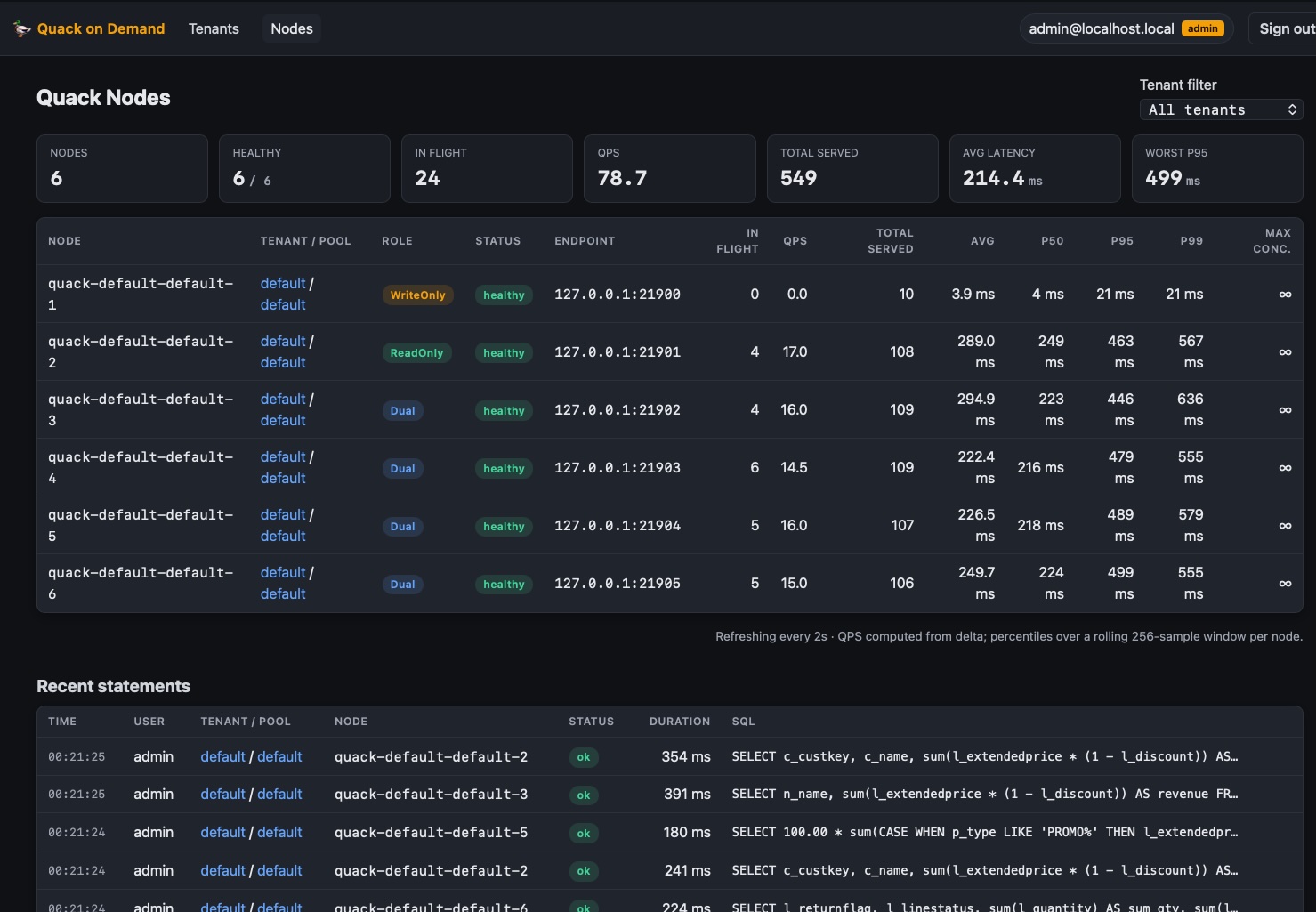
- Every statement is attributed to the acting token, live-killable, and audited. Revoking a token kills its live statements and every child it minted, in one call.
- Autoscaling & your IdP
- Fleets of DuckDB Quack nodes autoscale on your Kubernetes, or run as one Docker container. Sign-in through your IdP: OIDC SSO (Keycloak, Google, Azure AD, Cognito) with SCIM provisioning.
The agent-ready database
Built for the newest kind of database user.
An agent writes arbitrary SQL like an analyst, issues it at machine speed like an application - and nobody reads it before it runs. QoD is designed for exactly that caller: the policy lives on the credential, not in the prompt, because grants are the only thing an injected instruction cannot argue with.
MCP and ADBC
The agent never holds a database credential
Delegation is always a reduction
One enforcement path - no "agent mode"
Attributable, killable, audited
Decided inside the engine
Undo: agents write to branches
Your bucket, your cloud
Blast radius bounded by architecture
And underneath
Everything DuckDB Quack is missing in production.
DuckDB ships Quack as a minimal HTTP endpoint on localhost with a random token, and explicitly recommends a reverse proxy in front of it. QoD is that proxy - with the multi-tenancy, identity, and observability you need to actually expose it.
Arrow FlightSQL edge
Multi-tenant pools
Pluggable authentication
Enterprise identity - SSO & SCIM
Postgres-relational RBAC
Live admin console
Self-healing on restart
Deployment
Single binary
Configuration
Every key is overridable
Runtime
Single container or Kubernetes
Query federation
One SQL surface over every source.
QoD turns DuckDB's federation into a governed, multi-tenant service. Point a query at your lake, your Iceberg warehouse, and your operational databases at once - and join them in place, without moving a byte.
- 01
Query data where it lives
Object storage, Iceberg tables, and operational databases are read in place. No copies, no nightly ETL, no second engine.
- 02
Join across sources in one statement
A single SQL query spans Parquet on S3, an Iceberg warehouse, and a Postgres table - DuckDB pushes down filters and streams results back over Arrow.
- 03
Governed like everything else
Every federated table reference passes the same per-statement RBAC and table-ref policy checks - federation never bypasses your ACLs.
Parquet & CSVApache IcebergDuckLake catalogsPostgreSQLMySQLS3 / GCS / Azure Blob
federated.sql-- One statement, three sources, zero copies
SELECT o.region,
       c.segment,
       SUM(o.amount) AS revenue
FROM   read_parquet('s3://lake/orders/*.parquet')  o
JOIN   postgres_scan('crm','public','customers')   c
         ON c.id = o.customer_id
JOIN   iceberg_scan('s3://warehouse/products')     p
         ON p.sku = o.sku
GROUP BY 1, 2;
Bring your own pipeline
Works with any ETL, however you built your data.
QoD is a serving layer. It sits downstream of whatever produced your data. It does not care which tool wrote it, and it never routes your users anywhere.
Open source · Apache 2.0
Your agents are going to query production. Decide the terms.
The organisations that let agents in are the ones that can answer, without hedging: what can this agent see, what can it change, what did it do, and how do I stop it. QoD answers all four - on the same enforcement path as every human caller. Start with one command: uvx qod@latest serve --demo, then point your agent at /mcp with a token and ask it something.